SUMMER · MAY 21, 2026 · WEEK 20
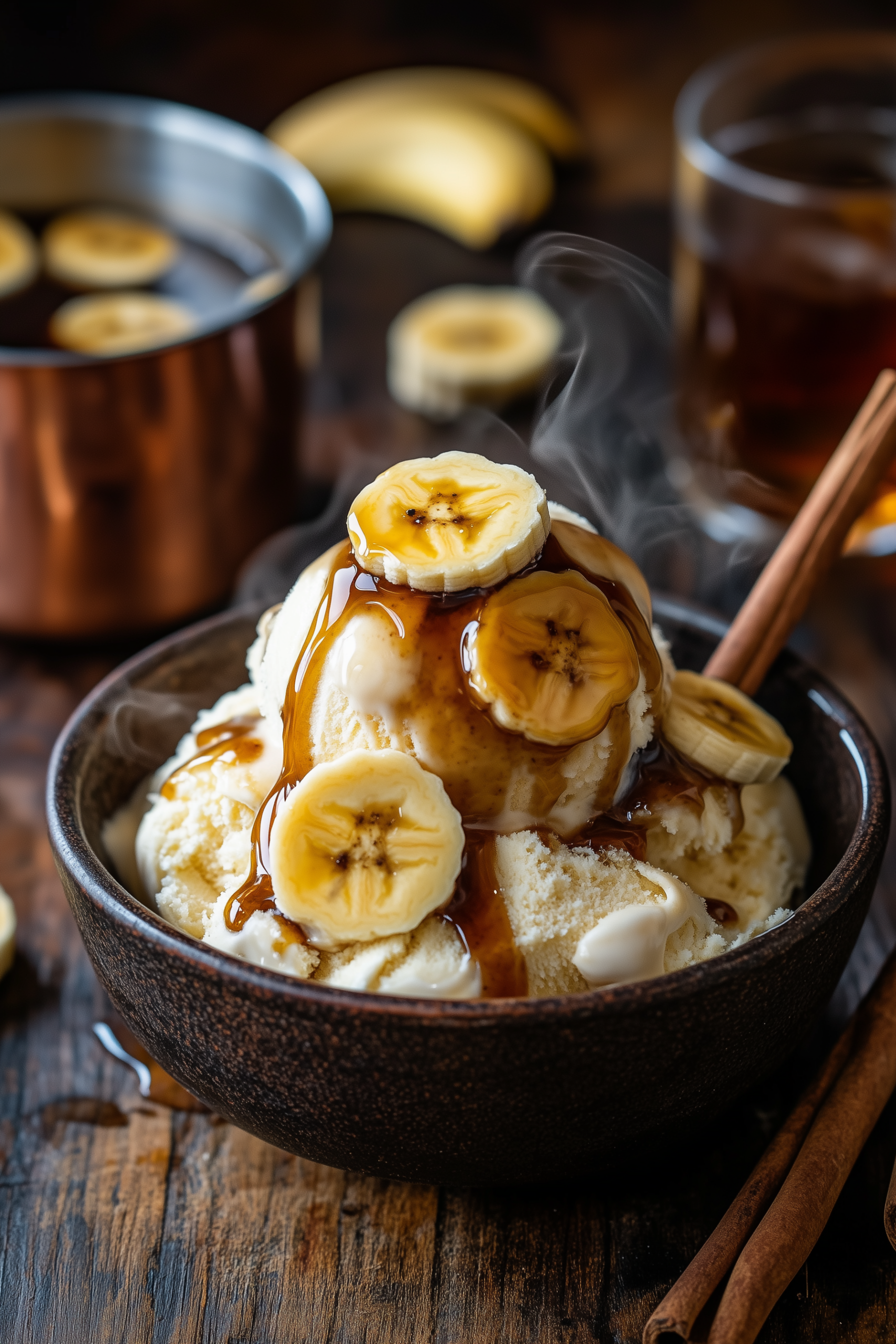
White rum, lime zest, dark rum caramel, mashed banana, and brown butter. The daiquiri and bananas Foster, frozen and improved.
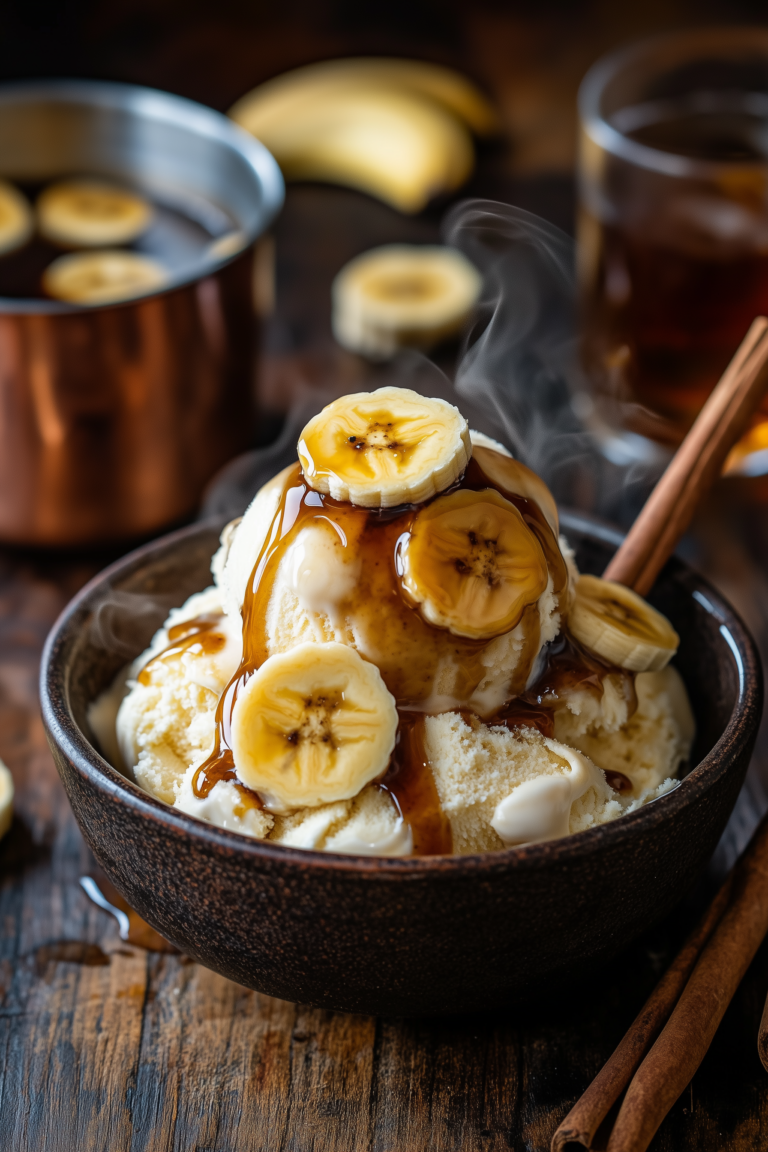
The Daiquiri Banana Foster ice cream recipe converts two cocktail traditions into a single frozen custard. The base carries the white rum and lime zest of a classic daiquiri. A dark rum-caramelized banana swirl runs through it, bringing the brown sugar, butter, and warmth of Bananas Foster. The defining technique is the swirl itself. Bananas are mashed into the caramel rather than left as coins, because intact banana pieces freeze hard and chewy in home freezers. The lost visual identity returns at service. Fresh banana coins and extra sauce are reserved as a garnish, either drizzled cold or caramelized in a pan for the full Foster contrast of hot sauce against cold ice cream. The Ninja Creami version reduces both rums to keep them within the reliable freezing range for a 24-hour pint. Three machine methods, gram-precise, built for people who take both cocktails seriously.
For the science behind how white and dark rum interact with a frozen custard base, see our complete guide to alcohol in ice cream. For rum’s freezing point, see the alcohol freezing point chart.
Why Two Rums and Mashed Banana Work in Ice Cream
Two spirits, two roles. White rum in the base (Bacardi Superior, Plantation 3 Stars, or any clean, unaged rum at 40% ABV) preserves the daiquiri’s identity in the cream and provides ethanol for freezing-point depression. Dark rum in the swirl (Myers’s or Gosling’s Black Seal) provides the molasses and burnt-sugar character that defines Bananas Foster, concentrated in a defined ribbon rather than diluted across the entire base. The swirl uses freezing-point depression to its advantage. High sugar concentration, alcohol, and butter fat together keep it pliable at freezer temperatures, so it ribbons cleanly when scooped instead of shattering. Mashing the bananas into the caramel is the unintuitive move that makes the recipe work. Intact banana coins inside the ice cream freeze rock-hard, but mashed banana incorporated into the caramel matrix stays soft. The visual Foster experience returns at service through fresh banana coins and reserved sauce, either drizzled cold or caramelized hot.
What You’ll Taste
Brown sugar and dark rum arrive first from the swirl: warm, faintly smoky, with the molasses depth of dark rum cutting through. The mashed banana ribbon delivers ripe banana flavor without the chewy texture of frozen banana pieces. The base provides clean cream and a thread of white rum and lime zest underneath the swirl. Recognizably daiquiri-adjacent, not competing with the Foster flavors. The brown butter in the sauce adds a nutty backbone that registers as richness rather than as butter specifically. Served with fresh banana garnish and extra sauce, the dessert reads as Bananas Foster with a daiquiri pulse underneath.
Daiquiri Banana Foster is a dual-spirit recipe with a deliberate structural choice: the alcohol is split between two locations, and only the alcohol in the base affects the ice cream’s freezing behavior. White rum at 40% ABV is integrated into the custard base. Dark rum at 40% ABV is cooked into the banana foster sauce — a separate phase, held at refrigerator temperature and applied as a swirl. The dark rum delivers flavor; the white rum carries the formulation work.
The Standard base is 2.2% ethanol by water weight (42g white rum in 715g cream and milk) — comfortably in the Conservative tier. The white rum’s job is twofold: to preserve the daiquiri’s identity in the cream and provide just enough ethanol to keep the base from churning rock-hard. The dark rum is not in the calculation at all. It enters the dessert through the swirl ribbons at service, where freezing-point depression is irrelevant — the swirl is meant to stay soft, ribbon cleanly, and deliver concentrated rum-caramel character against the cleaner base.
The Cuisinart variant contains 28g of white rum in 600g of cream and milk, putting ethanol at 1.8% by water weight — also Conservative. The proportional reduction across batch sizes is deliberate.
The Ninja Creami variant uses 14g of white rum in a 504g base (cream, milk, sugar, cream cheese), resulting in 1.0% ethanol by water-weight, with sugar at 8% of base weight. Both numbers are well below all thresholds. Cream cheese (32 g, ~2 tbsp) acts as a stabilizer at the small fat-to-volume ratio, guaranteeing a clean process on the ICE CREAM setting. The Creami’s sauce includes 21 g of dark rum, but per the dual-spirit principle, that rum lives in the swirl and is added via the MIX-IN function after the first spin — outside the base, outside the freezing math.
The choice of phase separation is why the recipe works. If both spirits were combined into the base, the Standard variant would be 4.8% ethanol by water-weight — at the upper edge of the Standard tier, with the corresponding loss of scoop firmness and a melt rate that ruins the dessert at room temperature. The Cuisinart variant would land at 4.2%, the Creami at 2.7% by simple math, but at a small-batch scale where compound effects from brown sugar, butter, and banana would prevent the 24-hour solid freeze the Creami requires. Phase separation is not a flavor preference. It is the formulation discipline that makes the recipe physically possible.
The mashed-banana technique is also load-bearing on the alcohol math. Banana fruit is roughly 75% water and 20% sugar, with negligible alcohol. Mashed bananas in the cooked-down caramel sauce contribute sugar and water to the swirl phase, not to
the base. If the bananas were instead folded into the base as coins or purée, the additional sugar and water would alter the base’s freezing behavior, causing the Banana Foster flavor to diffuse rather than concentrate. The mash-into-sauce step keeps the formulation clean.
For the full science of how phase separation works in dual-spirit recipes, why only base alcohol counts toward freezing-point depression, and how the threshold ladder generalizes (or fails to generalize) for swirl-based recipes, see our complete guide to alcohol in ice cream and the alcohol freezing point chart.